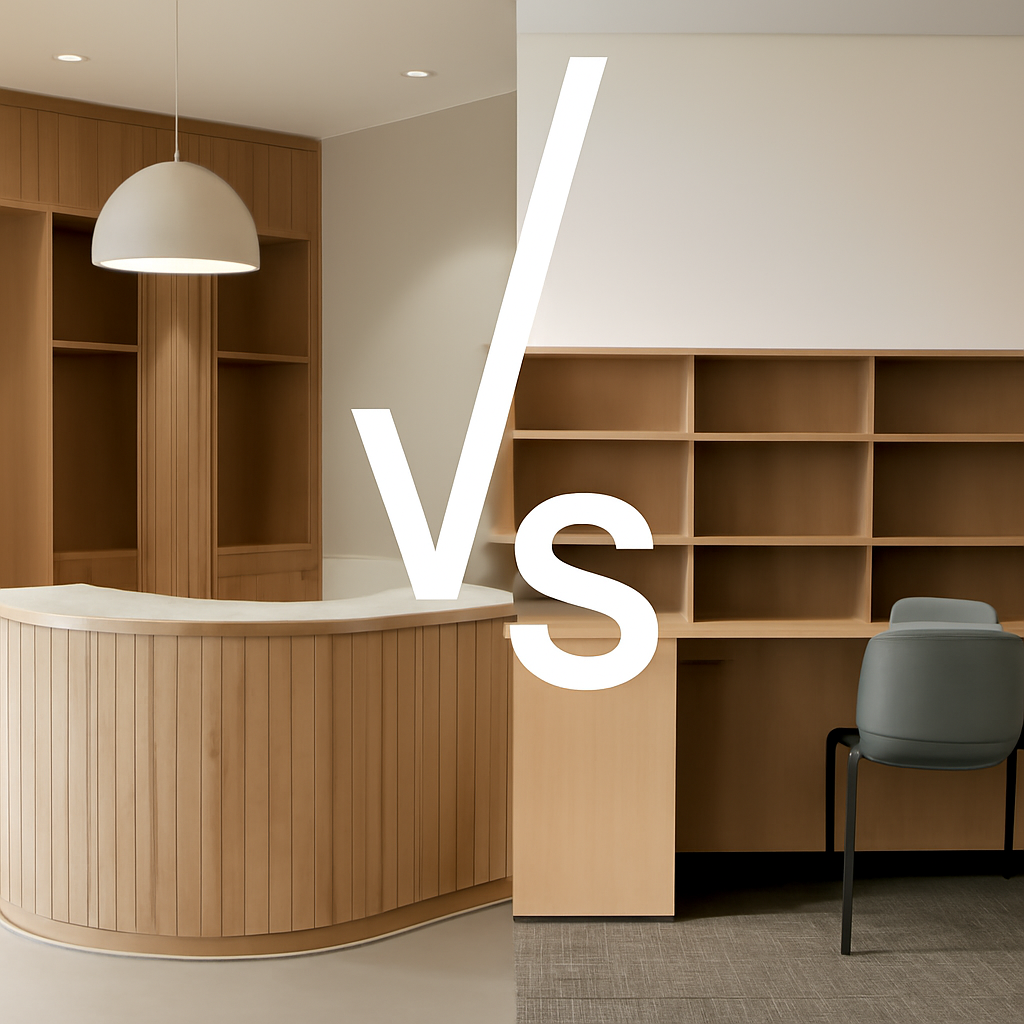
Custom Joinery vs. Off-the-Shelf: When Bespoke Wins in Commercial Spaces
INTRODUCTION
When outfitting a commercial space, every square metre represents an investment in your brand’s future. The decision between custom joinery and ready-made furniture can feel like a crossroads, with budget constraints pulling one way and vision pulling the other. This article explores the distinct advantages of bespoke solutions and helps you identify when custom joinery delivers returns that off-the-shelf alternatives simply cannot match.
SECTION 1: Understanding the Fundamental Differences
Custom joinery refers to furniture and fittings that are designed and built specifically for a particular space, according to precise measurements and client specifications. Off-the-shelf options, by contrast, are mass-produced items available in standard sizes and finishes. The distinction goes beyond aesthetics. Custom joinery integrates seamlessly with your commercial environment, wrapping around structural columns, fitting into awkward corners, and accommodating specific workflow requirements. For small business owners in Dubai’s competitive market, this precision can mean the difference between a space that feels generic and one that tells your brand’s unique story. While the upfront cost of custom work is typically higher, the value lies in perfect fit, enhanced durability, and the elimination of gaps that collect dust or waste valuable floor area.
SECTION 2: Maximising Every Square Metre of Your Commercial Space
In Dubai, where commercial real estate commands premium rates per square foot, efficient use of space is non-negotiable. Off-the-shelf furniture comes in predetermined dimensions that rarely align perfectly with your floor plan. This mismatch creates dead zones—those awkward gaps behind desks or beside cabinets that serve no purpose. Custom joinery eliminates this waste entirely. A bespoke reception desk can curve gracefully around a structural pillar, turning an obstacle into a design feature. Built-in shelving can extend from floor to ceiling in a narrow alcove, providing storage that off-the-shelf units cannot fill. For retail spaces, custom display units can be designed to guide customer traffic naturally toward high-margin products. When you calculate the annual cost per square metre of your commercial lease, the efficiency gains from custom joinery often offset the higher initial investment within months.
SECTION 3: Brand Identity and Customer Experience
Your physical space communicates with customers before a single word is exchanged. Off-the-shelf furniture, by its nature, is available to your competitors. Walk into any business district in Dubai and you will see identical desks, identical shelving, and identical waiting area chairs. Custom joinery allows you to break free from this visual monotony. A boutique hotel lobby with a one-of-a-kind check-in counter crafted from local materials creates an immediate impression of exclusivity. A café with custom banquette seating that mirrors the brand’s colour palette and logo pattern becomes instantly Instagrammable. For professional service firms, custom cabinetry in client meeting rooms can incorporate subtle branding elements while providing practical storage for presentation materials. This level of differentiation builds brand recall and justifies premium pricing. In a market saturated with choices, the physical environment becomes a powerful differentiator that off-the-shelf solutions cannot replicate.
SECTION 4: Long-Term Value and Adaptability
The initial cost of custom joinery often gives small business owners pause, but a lifecycle cost analysis tells a different story. Mass-produced furniture typically uses lighter materials and joinery methods designed for cost efficiency rather than longevity. Particleboard shelves sag under weight, laminate edges peel, and drawer slides fail after a few years of commercial use. Custom joinery, built by skilled craftsmen using solid materials and robust construction techniques, often lasts decades with proper maintenance. Furthermore, well-designed custom pieces can be adapted as your business evolves. Modular custom shelving systems can be reconfigured when inventory changes. Reception desks can be refinished to match a rebranding effort. When you factor in replacement costs, disposal fees, and the disruption of swapping out furniture every few years, custom joinery frequently proves more economical over a five-to-ten-year horizon. For small businesses planning sustainable growth, this durability represents genuine financial wisdom.
KEY TAKEAWAYS
- Custom joinery maximises usable space by fitting precisely to your floor plan, eliminating dead zones that waste expensive commercial square footage.
- Bespoke solutions create unique brand experiences that off-the-shelf furniture cannot match, helping your business stand out in Dubai’s competitive market.
- While initial costs are higher, custom joinery offers superior durability and adaptability, often proving more cost-effective over the long term.
- Custom pieces can be designed to support specific operational workflows, improving staff efficiency and customer satisfaction.
- Working with a professional joinery team ensures compliance with local building codes and fire safety regulations, which off-the-shelf solutions may not address.
FAQ
Q: Is custom joinery only for large corporations with big budgets?
A: Not at all. Many joinery workshops in Dubai work with small businesses and offer scaled solutions. A single custom reception desk or a set of built-in shelves can be surprisingly affordable, especially when you factor in the long-term value and space efficiency gains.
Q: How long does a custom joinery project typically take from design to installation?
A: For a small commercial space, the process usually takes four to eight weeks. This includes initial consultation, design finalisation, material selection, fabrication, and installation. Planning ahead for seasonal slow periods can help minimise disruption to your operations.
Q: What materials are commonly used for commercial custom joinery in Dubai?
A: Popular choices include solid hardwoods like oak and walnut, high-quality MDF with veneers, engineered quartz for countertops, and powder-coated metals for structural elements. Your joinery partner can recommend materials suited to Dubai’s climate and your specific usage requirements.
CONCLUSION
The choice between custom joinery and off-the-shelf furniture ultimately comes down to what you value most for your commercial space. If your priority is minimising upfront expenditure and you have standard dimensions to work with, ready-made options may serve your immediate needs. However, if you are building a brand, maximising every square metre of your expensive Dubai lease, and investing in long-term operational efficiency, custom joinery offers returns that extend far beyond aesthetics. When you choose bespoke, you are not just buying furniture—you are commissioning a solution that works as hard as you do.